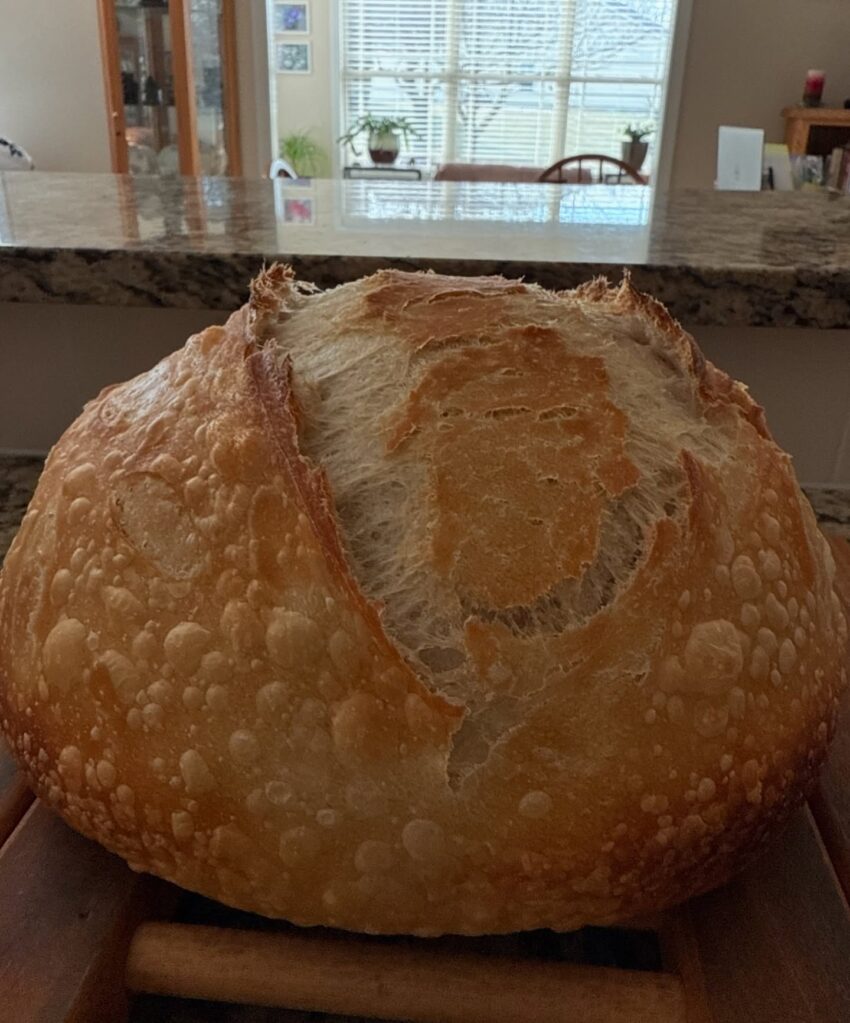
Unloaf sourdough bread refers to sourdough bread that is baked as a round or freeform shape, rather than in a loaf pan. It’s often referred to as a “round” or “boule”. Here’s a basic recipe for making a round sourdough bread without a loaf pan:
Ingredients:
- 1 cup (240g) active sourdough starter
- 1 1/2 cups (360g) lukewarm water
- 3 1/2 cups (440g) all-purpose flour (or a mix of bread flour and whole wheat flour)
- 1 1/2 teaspoons salt
- 1 teaspoon sugar or honey (optional)
Instructions:
1. Make the Dough:
- In a large bowl, mix the active sourdough starter and lukewarm water together until the starter is dissolved.
- Add the flour, salt, and sugar (if using) to the bowl and stir until a rough dough forms.
- Turn the dough out onto a clean surface and knead for about 8-10 minutes, or until the dough is smooth and elastic. If the dough feels too sticky, add a little more flour, but be careful not to add too much—keep it on the softer side.
2. Bulk Fermentation:
- Place the dough in a clean, lightly oiled bowl and cover it with a damp towel or plastic wrap.
- Let it rise for 4-6 hours at room temperature, or until it has doubled in size. Alternatively, if you’re doing a cold fermentation (for a more developed flavor), place it in the fridge for 12-18 hours.
- During the first 2 hours, perform a set of stretch and folds (pull the dough from one side and fold it over itself), every 30 minutes. This helps build structure in the dough.
3. Shape the Dough:
- Once the dough has doubled, gently deflate it and turn it out onto a clean work surface.
- Shape the dough into a tight round ball (boule) by folding the edges of the dough under itself and then pinching them to form a seam.
- Let the dough rest for about 10 minutes, then give it one last shape, ensuring it’s tight and smooth.
4. Proof the Dough:
- Place the dough seam-side down on a piece of parchment paper or a well-floured proofing basket (banneton). Cover it with a damp cloth or plastic wrap.
- Let the dough proof for 1-2 hours at room temperature, or until it has puffed up and holds an indentation when gently pressed with a finger. If you want to bake it the next day, you can place it in the fridge to proof overnight (cold proofing).
5. Preheat the Oven and Dutch Oven:
- Preheat your oven to 475°F (245°C). If you’re using a Dutch oven (which is highly recommended for a great crust), place it in the oven while it preheats. The hot pot will trap steam, giving the bread a crispy, chewy crust.
- If you don’t have a Dutch oven, you can bake it on a baking stone or sheet, but you may want to add steam by placing a pan of water in the bottom of the oven.
6. Score the Dough:
- Once the dough has proofed, carefully flip it onto a piece of parchment paper (if you’ve been using a proofing basket).
- Use a sharp knife or razor blade (lame) to score the top of the dough. You can make a simple cross or any pattern you like. This helps the bread expand evenly as it bakes.
7. Bake the Bread:
- Carefully transfer the dough, along with the parchment paper, into the preheated Dutch oven.
- Cover the Dutch oven with its lid and bake for 20 minutes at 475°F (245°C).
- After 20 minutes, remove the lid and reduce the oven temperature to 450°F (230°C). Continue baking for another 20-25 minutes, until the bread is golden brown and sounds hollow when tapped on the bottom.
- If you’re not using a Dutch oven, bake the bread directly on a baking sheet or stone, adding steam to the oven (a few ice cubes or a pan of hot water works well).
8. Cool the Bread:
- Remove the bread from the oven and let it cool completely on a wire rack before slicing.
Tips:
- Starter: Make sure your sourdough starter is active and bubbly. Feed it 6-8 hours before you plan to use it.
- Hydration: If the dough feels too dry, add a little more water (a tablespoon at a time), as sourdough can vary in hydration levels.
- Steam: If you’re not using a Dutch oven, create steam in the oven by placing a pan of water on the bottom shelf. This helps create a crispy crust.
- Flavor: You can add herbs, seeds, or other flavorings to the dough before shaping it if desired.
Enjoy your homemade unloaf sourdough bread! It’s perfect with butter, jam, or as a side to soups and salads.